Beauty trend predictions you can check
Turn a beauty trend hunch into a clear question. Record your confidence before the result, then check your prediction against evidence.
Use this guide for product launches, refill formats, fragrance releases, and brand announcements. The calculator measures past predictions; it does not predict the next beauty trend.
Beauty forecast score calculator
Enter the chance you gave each event before its deadline. Select the verified outcome. Leave unresolved events as “Pending” to exclude them.
The starting values are invented examples, not live forecasts or measured beauty industry data. Replace them with predictions from your own notes.
Use a probability from 0% to 100%. Empty or invalid values in resolved rows need correction.
Method: Beth Ebert, Bureau of Meteorology Research Centre (BMRC), Verification of Probability Forecasts (2007), hosted by ECMWF. Binary Brier score = mean((p − o)²). The probability p runs from 0 to 1. The outcome o is 1 for happened and 0 otherwise. Lower scores are better; 0 is perfect and 1 is worst.
Each resolved prediction has equal weight. The calculator uses your inputs only. It sends no forecast data and saves no forecast history. Copy your results before leaving.
Make a beauty prediction that can resolve
“Refillable fragrance will be everywhere” leaves too much room for interpretation. Choose a named brand, a product format, a market, and a deadline instead. A useful question asks whether the brand will offer a refill bottle for a specified fragrance on its official store by your chosen date.
Write the rule before you assign a probability. Decide whether an announcement counts, or whether customers must be able to buy the product. Specify whether a travel size counts as a refill. Keep a copy of the current product page so you can distinguish a new launch from an existing listing.
For a shade expansion, define the product line and the minimum addition in advance. For a packaging change, state whether a limited edition qualifies. These are suggested ways to frame your own questions, not predictions about any named company.
Separate an announcement from a beauty trend
Start with the evidence that can answer your exact question. Use a brand announcement for an announcement question. Use the official product listing for an availability question. If you ask about sales, require a published sales measure with the relevant category, geography, and period.
Do not substitute views for purchases or a sold-out notice for a sales total. Record what the evidence actually shows. An item can meet your launch rule without proving that its format has broad demand. Keep those conclusions separate in your notes.
Check whether an endorsement includes a disclosure. The US Federal Trade Commission’s Endorsement Guides, revised in 2023, call for disclosure of unexpected connections that could affect an endorsement’s credibility. Treat a sponsored beauty post as promotional evidence when you assess a trend.
For each question, record the source title, publication date, exact claim, and your reason for accepting the result. If the source disappears or the outcome remains ambiguous, keep the prediction pending. Do not turn missing evidence into a confirmed failure.
Learn from confidence, not just wins
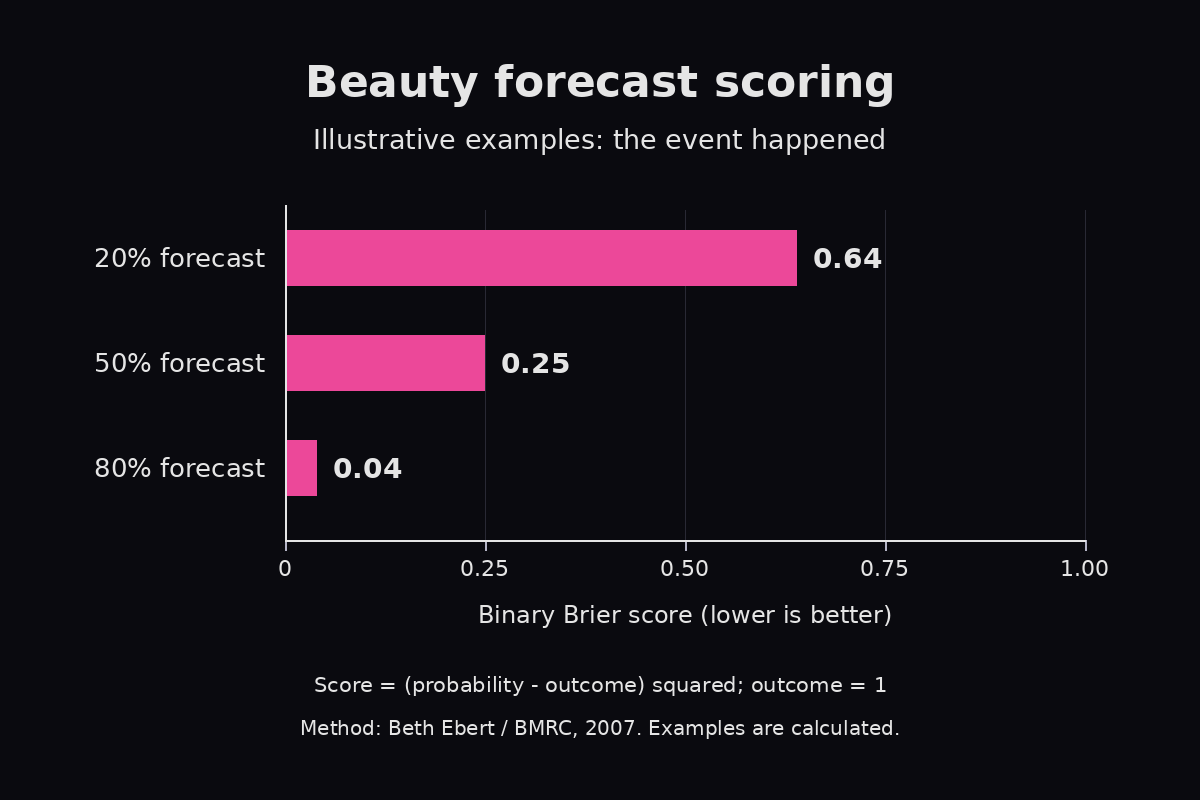
A prediction can sound confident and still be wrong. The squared error gives a larger penalty to a confident miss. For example, an 80% prediction scores 0.64 if the event does not happen, compared with 0.04 if it happens.
A constant 50% forecast scores 0.25 for either outcome. That is a comparison point, not a universal pass mark. Ebert’s 2007 workshop notes explain that event frequency affects the Brier score. Compare predictions for similar questions and time horizons.
Keep the original probability even when later news changes your view. If you update a prediction, record that as a separate dated entry. Review all resolved questions rather than selecting your best results. A small set of examples cannot establish forecasting skill.